


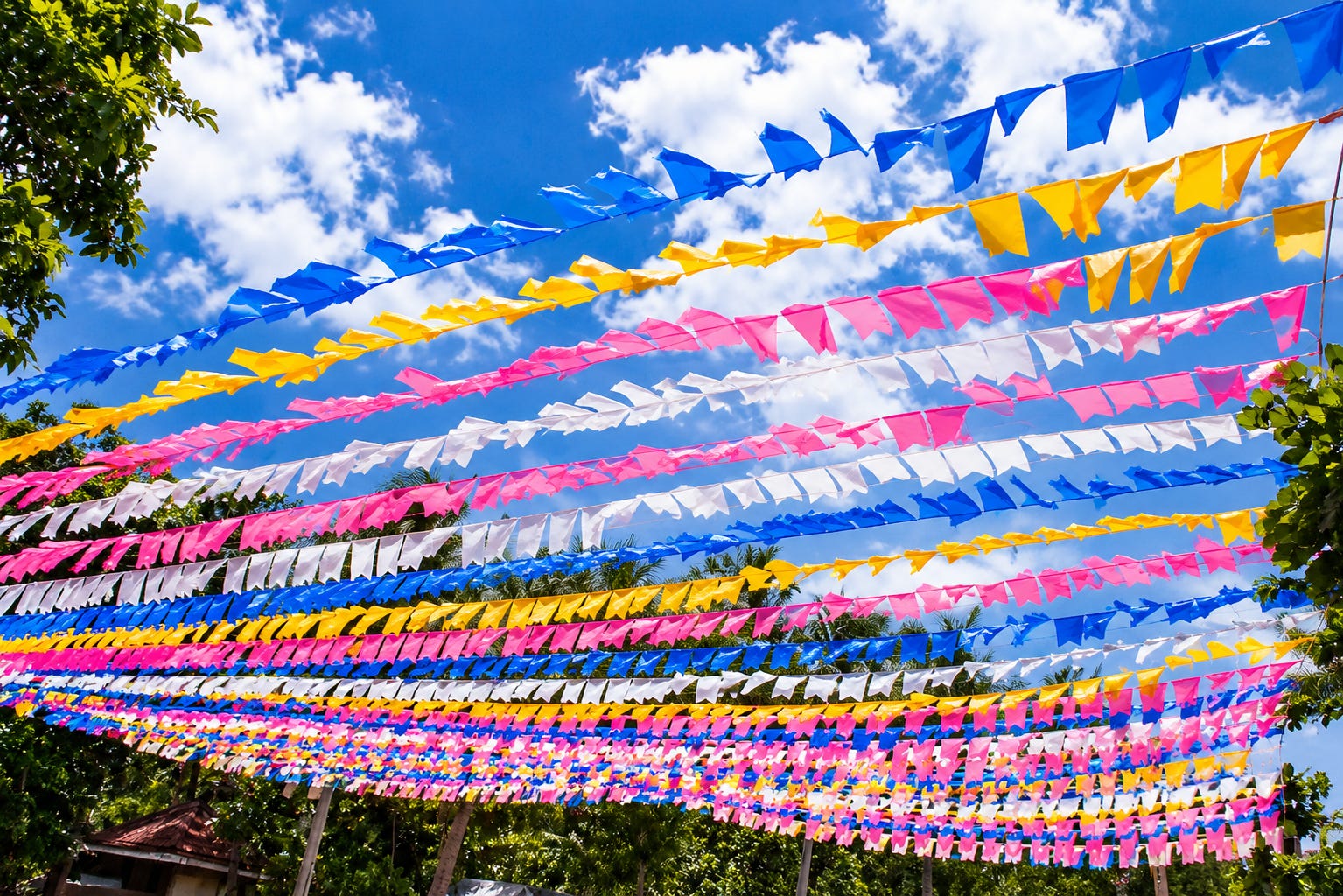
Banderitas are simple strings of colorful triangular flags traditionally hung during fiestas, religious celebrations, and community gatherings throughout the Philippines.
Derived from the Spanish word bandera (flag), these simple but vibrant buntings have become one of the country’s most recognizable symbols of celebration. They transform ordinary streets into festive spaces and serve as a reminder that something worth celebrating is just around the corner.
I have walked under these plastic flags so many times in my life that the whole experience basically became invisible to me. I used to just wave them off, completely taking this chaotic, colorful canopy for granted as I sidestepped street dogs and dodged tricycles.
But stopping actually to look up makes it all incredibly visceral again - the tangled webbing of primary colors cutting across the glaring tropical sun, snapping in the wind, like the last town fiesta just happened a few minutes ago.
If you want to understand the architecture of a Philippine street, you have to look past the concrete and the corrugated iron roofs. You have to look up at the airspace. In almost every barangay, provincial town, or crowded city alleyway, the sky is crisscrossed by a wild, geometric webbing of banderitas - our fiesta buntings.
They are as much a part of the local infrastructure as the electrical wires they cling to. This distinctly Filipino aesthetic turns a dusty, ordinary road into an open-air convention of celebration.
Claiming the Sky
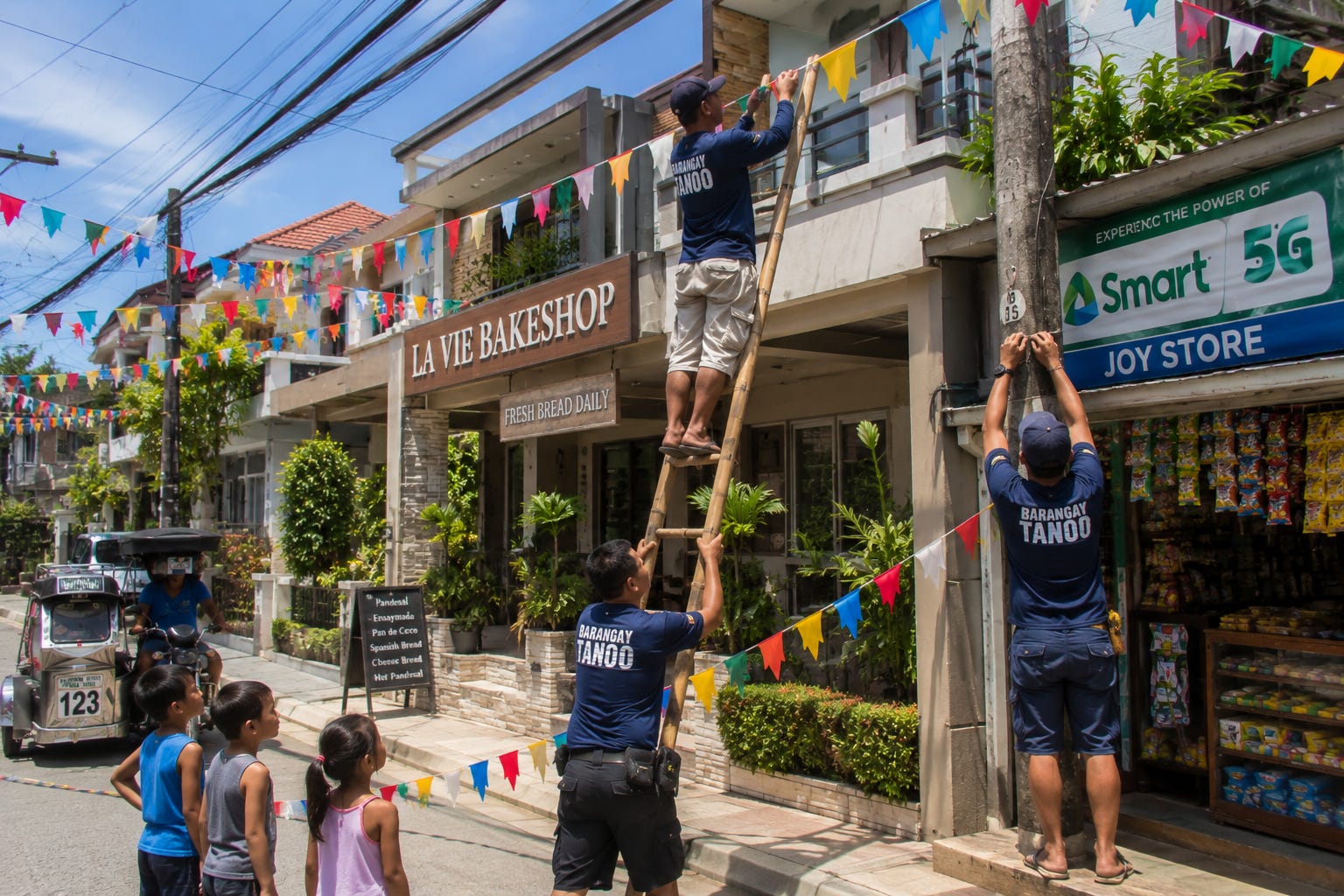
The hanging of the banderitas begins weeks before the actual event. Local neighborhood uncles or barangay tanods (village guards) go out in the midday heat, armed with rolls of nylon string, a staple gun, and a terrifyingly rickety bamboo ladder. Sometimes, if the town is well-connected, they will borrow the local electric cooperative’s bucket truck.
There is no formal blueprint, no structural engineering at play. The anchor points are purely dictated by whatever is available. A line of nylon is tied to a sloping telephone pole, stretched tightly over the asphalt, and anchored to the rusty second-story grill of a neighborhood bakery.
Another line zigzags from the branches of an ancient mango tree down to the wooden awning of a sari-sari store. They weave through the dangerous, tangled birds’ nests of electrical and internet cables, creating a chaotic, intersecting net over the street.
They go up for almost any reason worth celebrating. In May, it’s for the Flores de Mayo. In September, entire avenues in Naga City vanish under a ceiling of plastic banderitas in anticipation of the Peñafrancia festival. They go up for local elections, for a barangay anniversary, or for the feast day of a patron saint whose history half the neighborhood doesn’t even know.
They also go up for fun-run events sponsored by multinational companies. The reason barely matters; what matters is the visual loudspeaker. The banderitas are a geographical marker. They boldly declare: Right here, in this specific spot, we are choosing to celebrate.
The Roof of the Party
The material itself is unapologetically cheap. These aren’t the thick, embroidered cloth pennants you might see in a European plaza. They are made of incredibly thin, translucent plastic.
Sometimes they are sharply cut into triangles; other times, they are fringed rectangles. Often, they are heavily branded donated by local politicians whose smiling faces are printed on every third flag or sponsored by gin and instant coffee companies.
But when strung together by the thousands, that cheap plastic takes on a life of its own. It redefines the street. During the height of the fiesta, the banderitas function as the roof of the party.
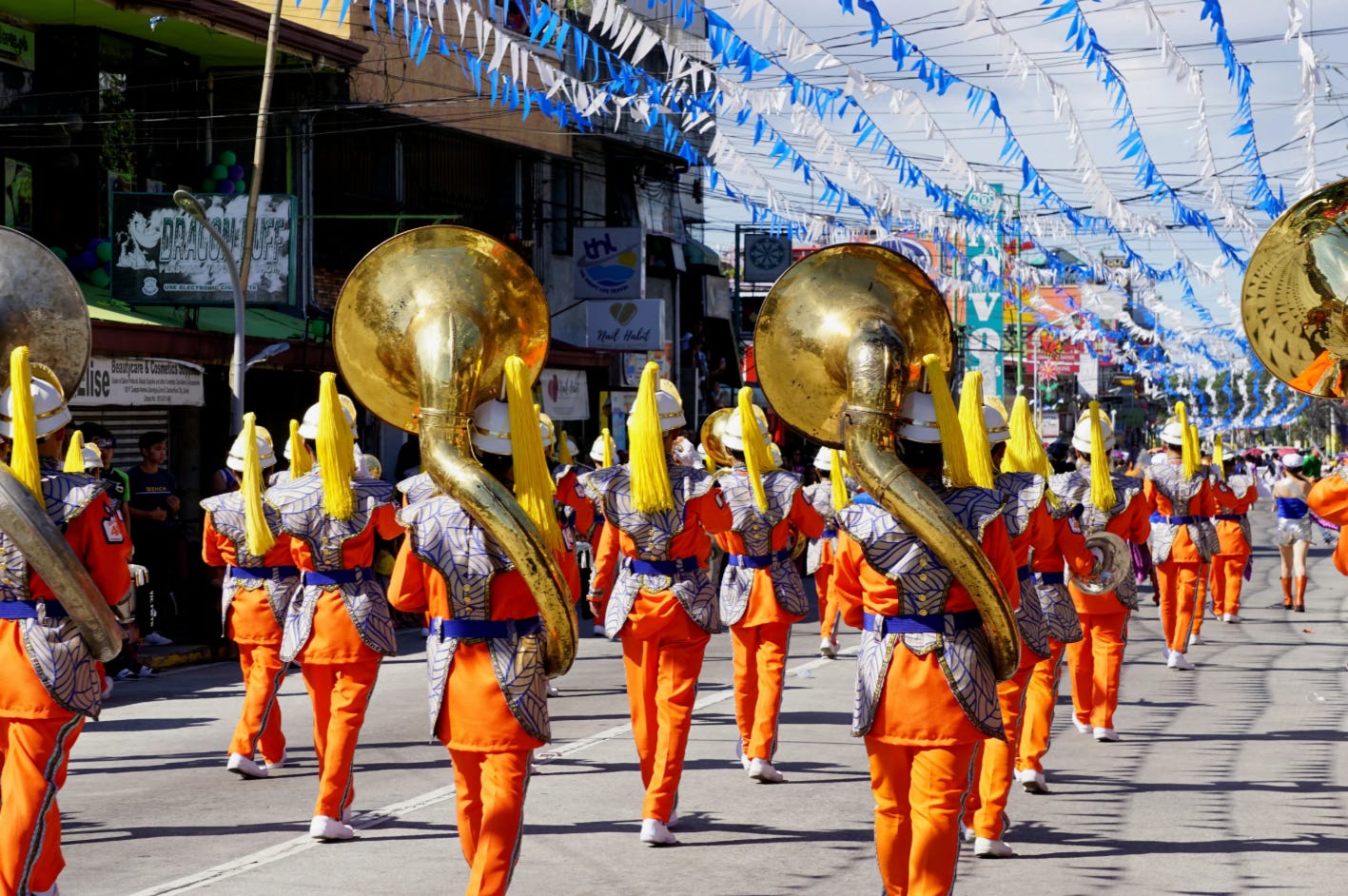
Below them, brass bands march in mismatched uniforms, teenagers crowd around roaring sound systems, and the heavy, intoxicating smoke of roasting pork belly and grilled chicken intestines overwhelms the senses.
And then there is the sound. When the heavy, humid tropical wind blows down the street, the thousands of tiny plastic flags snap and rustle all at once. It’s a rapid, frantic thwack-thwack-thwack that acts as the constant, vibrating backbeat to the noise of the street. It is the sound of collective joy.
When the Party Ends
But the most fascinating thing about the banderitas isn’t when they go up. It’s how they stay up.
When the fiesta ends, the marching bands go home. The wooden karaoke stages are quickly dismantled, and the streets are swept clean of empty beer bottles and bamboo skewers. The party vanishes overnight. But the banderitas? They stay.
No one takes them down. Practically speaking, it’s far too much effort to climb back up those bamboo ladders just to dismantle cheap plastics. But culturally, leaving them up feels like an unspoken refusal to admit the celebration is entirely over. Taking them down feels too final, too abrupt a return to the grinding reality of daily life. So, we leave them to the elements.
The Afterlife
This begins the beautiful, melancholic afterlife of the fiesta buntings. They are left hanging there, fully exposed to the brutal, unforgiving Philippine sun and the violent lashings of the monsoon rains. Over the next few months, you can watch them physically decay, acting as a strange, visual timeline of the neighborhood.
First, the colors surrender. The vibrant, screaming reds break into a bruised, muted pink. The sharp yellows fade into a sickly cream, and the deep blues turn into ghostly, translucent gray. The smiling faces of the politicians slowly fade to nothing, leaving them as featureless, pale squares hovering over the traffic.
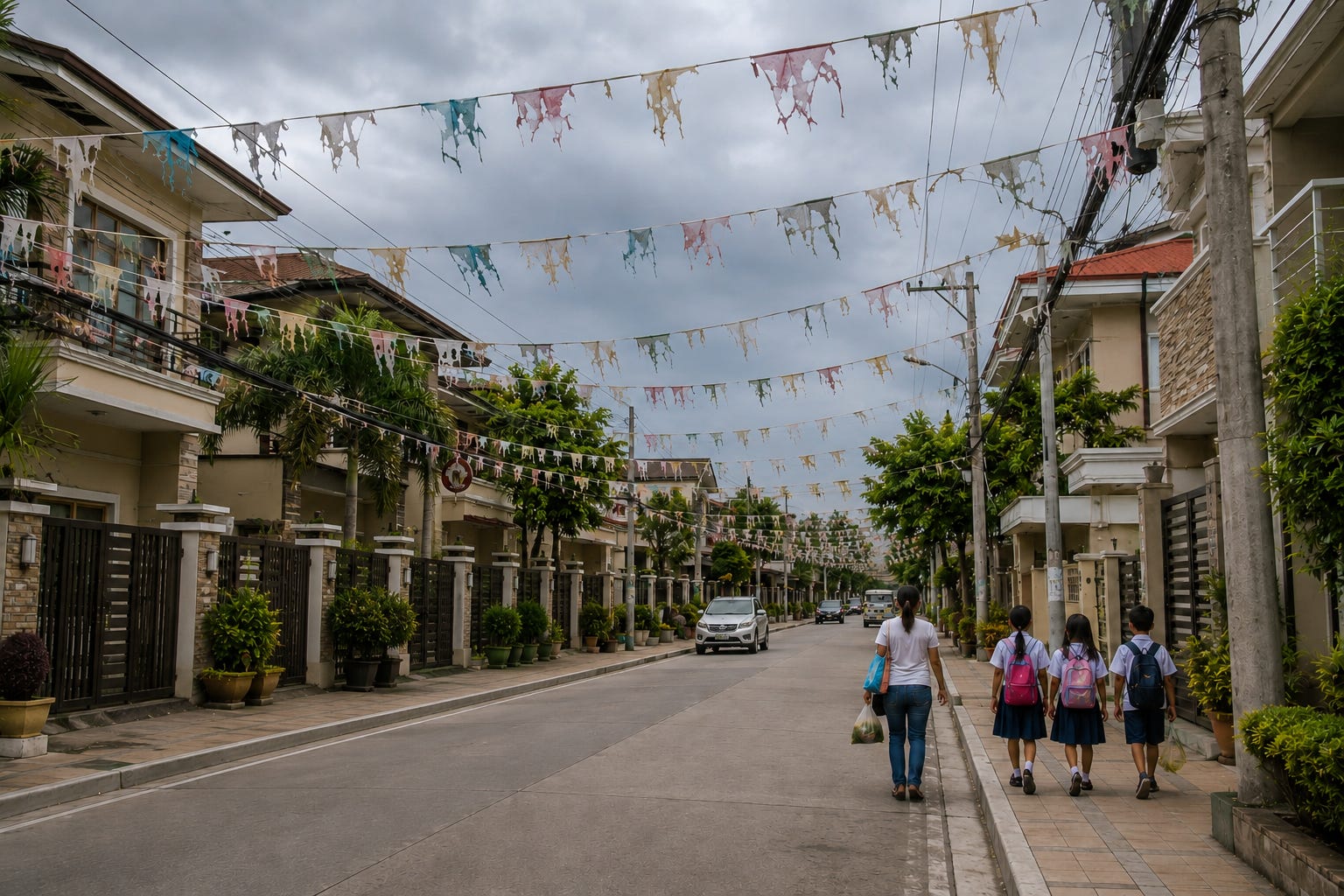
Then, structural integrity gives way. The plastic turns dry and brittle. When the typhoon winds come, the triangles are shredded, tearing away from the nylon strings. They become jagged little ribbons, fluttering weakly like tattered flags on a ghost ship.
Eventually, months or even a year later, all that is left is the bare nylon string itself, swaying silently among the telephone wires, with only a few stubborn, microscopic flakes of faded plastic still clinging to the knots.
They hang there like memories. Like the lingering, sun-bleached ghosts of a roaring night that everyone has already forgotten. They fade slowly, stubbornly, a quiet testament to the fact that for one weekend, this street was the center of the world. And they will hang there, fading into nothingness, right up until the uncles pull out the ladders once more… to string up the bright, new colors for the next year.