


Editor’s notes: This article touches on some plot details from Forgotten Island, including story and character beats. If you’d rather watch it fresh, you might want to come back to this one after.
The images accompanying this article are original conceptual illustrations created for Discover Philippines to complement the themes of this story. They are not scenes, stills, or official artwork from Forgotten Island.

I watched Forgotten Island yesterday with my wife and a dear friend, and there’s a moment early into the movie when you realize something unusual is happening: you’re not just watching another animated fantasy, you’re watching our stories.
The lechon. The karaoke. The tinikling. A tita giving directions by pointing with her lips instead of her hand. And then, of course, the creatures: duwende, tiyanak, aswang, and the one that terrified basically every Filipino kid growing up, the manananggal.
None of these needs much explaining if you grew up in the Philippines. It’s just part of growing up Filipino. Seeing it blown up large, beautifully animated, and sitting at the center of a Hollywood movie was, honestly, a strange kind of wonderful.
Two Friends, One Last Adventure
At its core, though, the film isn’t really about monsters. It’s about friendship. It follows Jo and Raissa, two lifelong best friends hitting that uncomfortable point where life starts pulling them in different directions — Raissa’s about to leave the Philippines to study abroad, and Jo isn’t ready to let her go.
On what’s supposed to be one of their last nights together, they stumble into a portal that drops them into Nakali (a playful shortening of the Tagalog word nakalimutan, which means “forgotten” or “to have forgotten”), an island full of the same creatures their families used to tell them stories about.
Getting home comes with a price, though: they might have to give up the memories of their friendship. What starts as a colorful adventure turns into something more tender than expected — how much are our memories worth, and what happens to a friendship when two people who grew up together finally have to grow apart?
It reminded me of a piece we ran a while back, The Filipino Friendship, about how deep those bonds tend to run for us. Close friends becoming something close to family, the kind you carry through every season of life, oceans included. That’s what makes Raissa’s departure land the way it does.
Her farewell party, too, felt like it could’ve walked straight out of the Filipino Fiesta: the food, the music, the relatives crowding in, the joyful chaos, that very Filipino instinct to turn even a goodbye into a celebration.
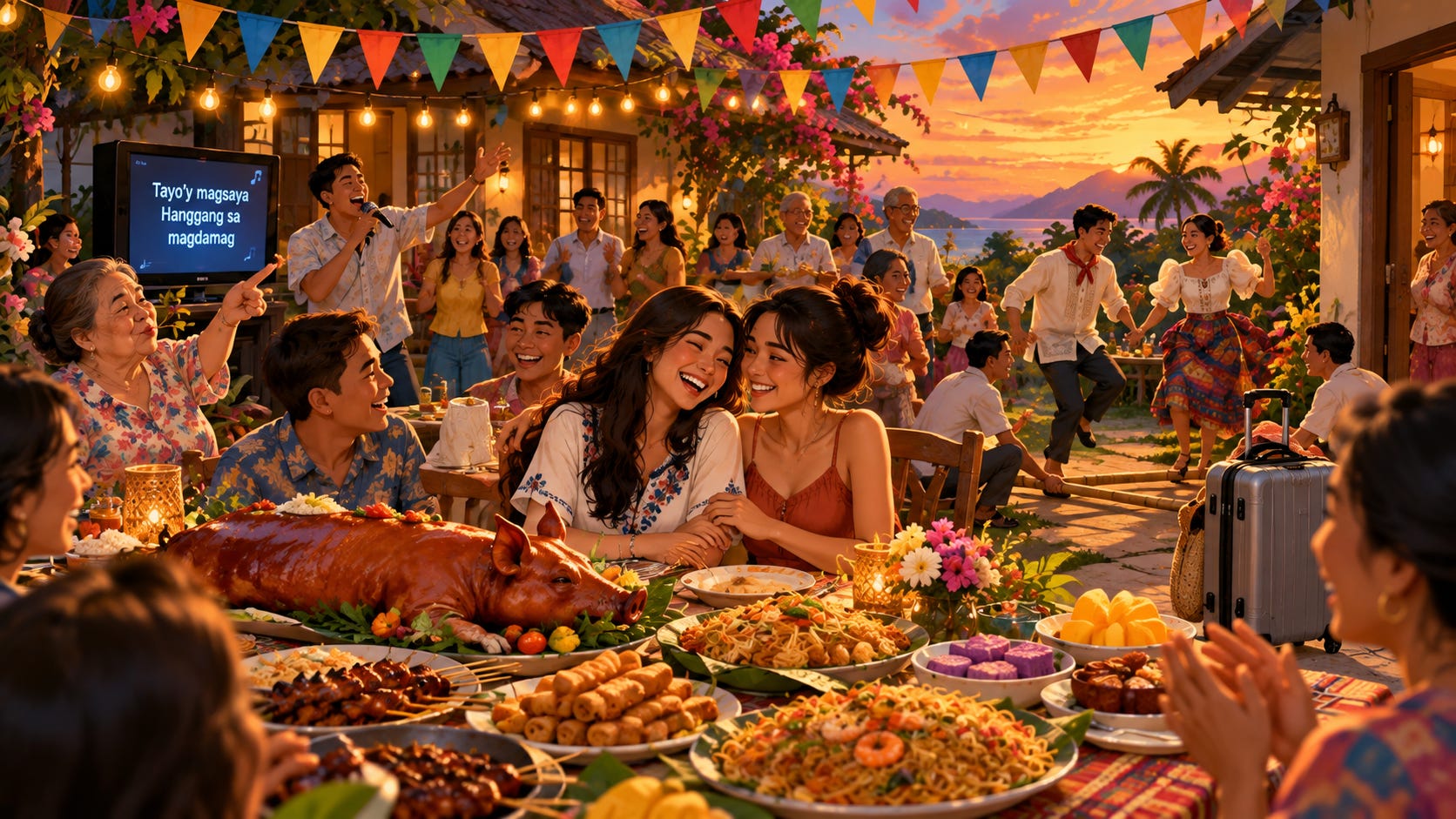
In both cases, the film gets something right about us that when someone we love is leaving, we gather, we eat, we laugh, and underneath all of it, we’re quietly holding on.
That friendship at the center of the story actually has roots in real life. Co-directors Joel Crawford and Filipino-American Januel Mercado have worked together for nearly two decades, and Mercado has called the film a love letter to Filipino culture. You can feel that in how the movie treats its setting. Jo and Raissa don’t feel like characters dropped into a “Filipino backdrop” because someone thought it’d look interesting. The world feels lived in.
A Party (and Some Monsters) We Know by Heart
One of my favorite parts of the movie happens before the actual adventure even starts — a Filipino party, and an unmistakable one at that. Karaoke, lechon, tinikling, Jo arriving by tricycle, someone acknowledging an image of Jesus on the wall, a tita pointing with her nguso at something across the room. Try explaining that last one to someone who didn’t grow up around Filipinos. You really can’t. We just know.
What makes it work is that the film never stops to announce itself. It doesn’t flash a banner that says “look, Filipino culture.” It just lets Filipino life exist on screen, which for Filipino viewers creates that specific feeling of recognition: we do that, my family does that, I’ve seen that a hundred times.
That’s probably one of the best versions of representation, not our traditions behind museum glass but folded into ordinary life, because that’s what culture actually is.
From there, the movie goes even deeper into Filipino folklore: kapres in the trees, duwendes in places we were told to leave alone, tiyanaks crying somewhere out of sight, aswangs at night, and the manananggal splitting itself in half to fly.
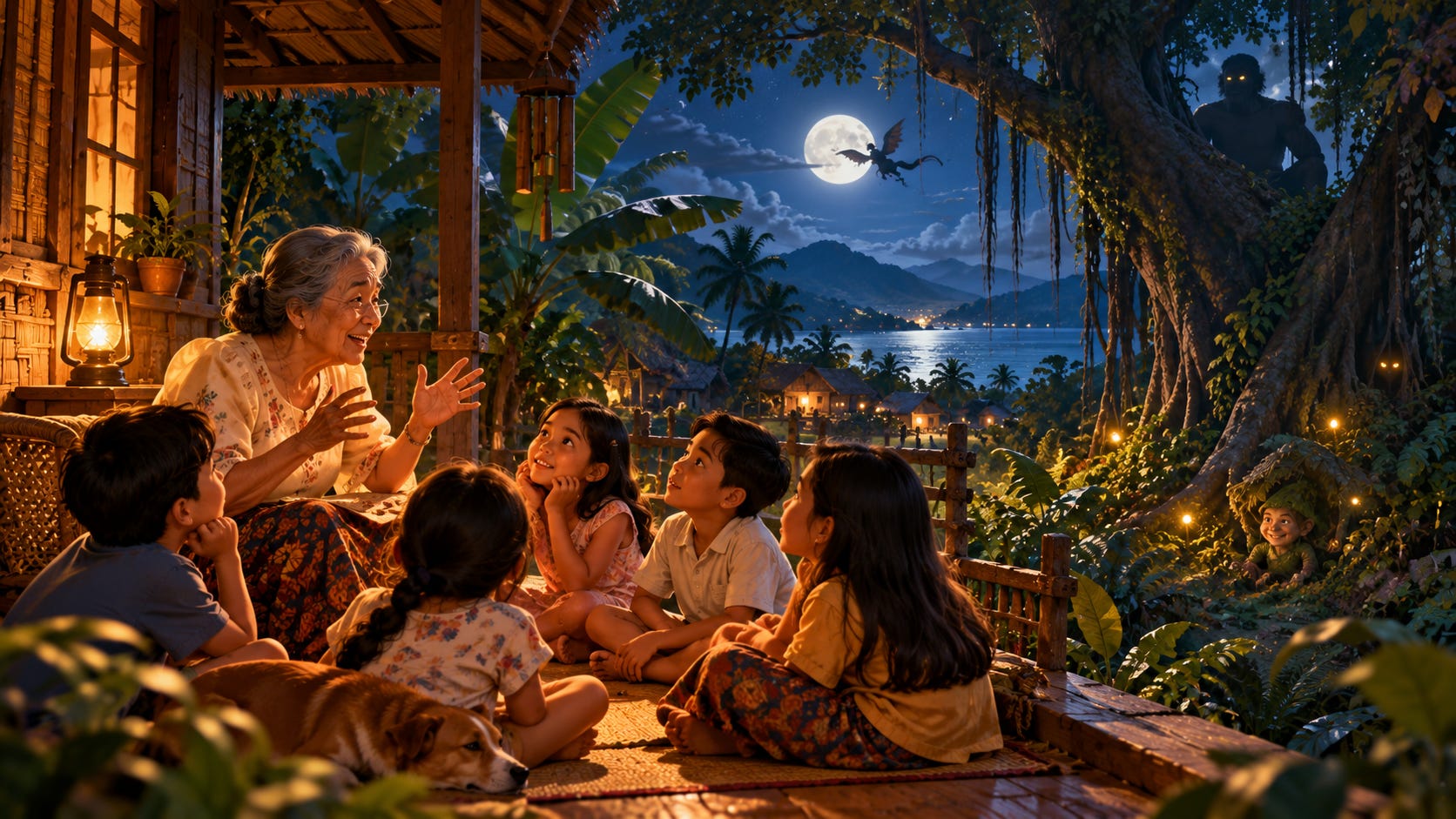
These stories got passed down for generations, sometimes for fun, sometimes to scare kids into behaving, and sometimes told with enough conviction you weren’t sure if the person telling it actually believed it.
H.E.R., who voices Jo and is of Filipino heritage, has talked about her own mother using manananggal stories to frighten her. That’ll sound familiar to plenty of us.
Our monsters didn’t live in books. They lived in the stories our elders told us, which is probably why seeing them reimagined as colorful animated characters feels oddly nostalgic.
DreamWorks essentially took creatures that used to live in whispered family stories and put them in front of a global audience, and it’s clear the filmmakers took that seriously. They did research in the Philippines and pulled feedback from Filipino employees throughout production.
Filipino Talent Shines
It’s not just what’s on screen, either. Filipinos helped build this thing. It’s being described as the first Philippine-themed animated feature out of a major American studio, with Filipino talent involved both in Hollywood and back home.
The voice cast includes H.E.R., Liza Soberano, Lea Salonga, Dolly de Leon, Manny Jacinto, and Jo Koy, and some of the hand-drawn animation came out of Snipple Animation Studios in Quezon City. Mercado has said he got emotional walking into that studio and seeing a full room of Filipino artists working on the film, which feels fitting. It’s a movie about Filipino imagination partly brought to life by Filipino talent.
We use the word “representation” so often these days it starts to sound like marketing copy. But sitting in a theater and watching something from your own childhood show up on screen is a good reminder of why it matters.
Filipinos have long been part of the machinery of global culture: our nurses, our seafarers, our musicians, our artists and animators scattered across countless international productions. Yet our own stories haven’t always traveled with us on the same scale.
That’s slowly shifting, and this film feels like part of that shift.
For some Filipino kid growing up in California or Toronto or Dubai, who’s heard Tagalog at home, maybe gotten an aswang story from their lola, knows lechon mostly from family parties, and has only been to the Philippines a handful of times (or not at all), walking into a theater and seeing it all on screen, not tucked apologetically into the background, is its own small thing worth having.
The Island We Carry With Us
There’s also a reason the story fits the Filipino experience so naturally beyond the folklore. It’s ultimately a story about leaving, and we know something about that. Someone’s always leaving for school, for work, for a contract overseas, sometimes for a few years, sometimes for good, and every departure carries the same quiet question about what happens to the people and places left behind.
For Filipinos overseas especially, memory becomes one of the ways we keep belonging to a place we’ve already left: the food, the noise, the fiestas, the jeepneys, the smell of rain on hot pavement, relatives we haven’t seen in years, even the monsters that used to scare us.
Distance has a way of turning the ordinary into something worth holding onto.

Forgotten Island will probably land for kids as a colorful adventure full of strange creatures and jokes. For the adults in the room, there’s a quieter film happening underneath. It’s about how growing up means leaving things behind, places changing, friendships shifting, families scattering, and how some of it stays with you anyway.
That’s the part that stuck with me most. The movie’s called Forgotten Island but watching it, I mostly found myself remembering the stories, the traditions, all those specific little things about Filipino life that feel completely ordinary until you’re thousands of miles from home and suddenly, they’re not.
So, to my fellow Filipinos, especially the ones who now call somewhere else home: tayo na.
Let’s go see it. Bring the kids, bring a friend, bring someone who’s never heard of a manananggal or danced the tinikling or sat through the joyful chaos of a Filipino despedida. Supporting a film like this is also a way of saying our stories matter, our artists deserve to be seen, and our culture belongs on the biggest screens out there.
You might walk in expecting an adventure about a forgotten island. You just might walk out, like I did, remembering home.