


You show up at the Ninoy Aquino International Airport armed with a pocket phrasebook, fully prepared to butcher the Filipino language. You have spent fourteen hours or so on a plane, repeating basic Tagalog greetings under your breath, smiling at the thought of Filipinos pleasantly surprised by your heavily accented Tagalog.
You step out onto the pavement, dodging aggressive taxi drivers in Manila, or maybe you’ve made your way down here to the quieter streets of Naga, and you tentatively ask a local for directions using your meticulously rehearsed Tagalog phrases.
The local looks at you, smiles warmly, and replies in completely flawless, rapid-fire English. It’s the greatest relief a traveler can experience. You realize very quickly that English is woven into the country’s very fabric.
It’s on the street signs, the menus, the television broadcasts. You toss the phrasebook into the bottom of your backpack, confident you won’t have any trouble getting around.
But you’re wrong.
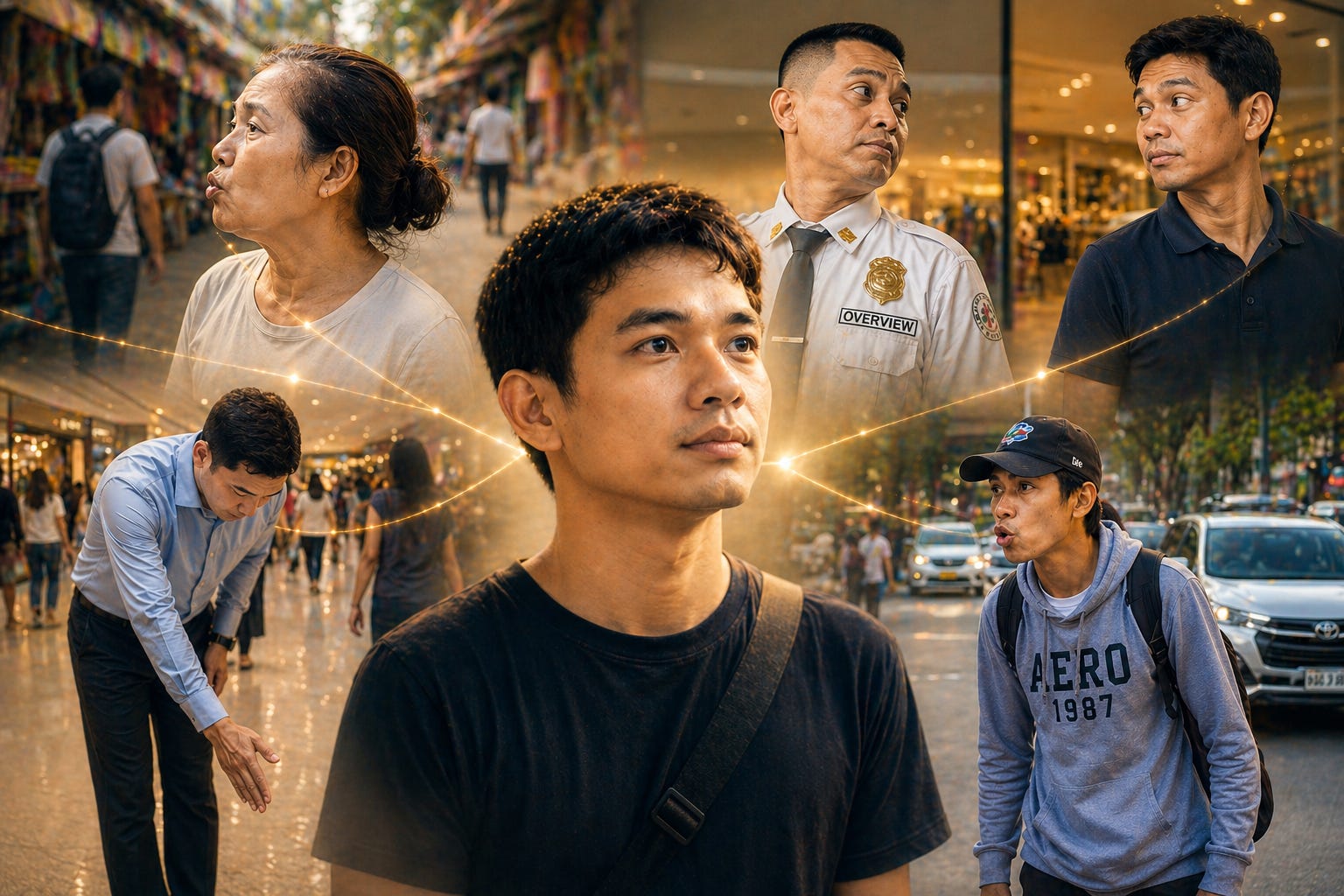
While you might understand the spoken words, you may be completely unfamiliar with the everyday language of the Filipinos. To truly communicate here, you have to realize that the most important conversations happen without making a single actual word.
The Sound That Gets Your Attention
The first shock to your system will be the auditory whip-crack of the universal “Psst.” In many Western countries, making a hissing sound is reserved for stray cats, and doing so to a human is considered aggressive street harassment.
It’s rude. It’s dismissive. But here, the sharp, sibilant “psst” is a surgical strike. It is the foundational cornerstone of getting someone’s attention.
It cuts straight through the overwhelming white noise of the street—the roaring diesel engines, the barking dogs, the thumping bass from a passing tricycle.

Abroad, we often joke that if you want to know whether Filipinos are walking among pedestrians on foreign streets, do the “pssst,” and all the Filipinos will turn their heads around.
It isn’t rude. It’s just efficient. It’s the great equalizer. You use it to flag down a jeepney, to get your friend’s attention across a noisy street, or to stop a guy pushing a cart of taho.
Once you get over the initial awkwardness and actually try it yourself, you realize the sheer, undeniable power of the hiss.
Directions Without Words
Then comes the complete dismantling of your understanding of pointing. If you ask that same local for directions to the nearest 7-Eleven, pay close attention to their hands.
They won’t move. Pointing your index finger at someone or something is often viewed as overly aggressive or accusatory. Instead, you have to watch their face. They will look at you, look down the street, and aggressively thrust their lips forward.

This is the nguso, the lip-point. It is an exact, localized GPS entirely operated by the lower half of the face. And it comes with degrees of severity. A gentle, quick pout means your destination is right around the corner.
A complete, strained neck extension, with the lips pushed out as far as physically possible, means you have a long, exhausting, sweaty walk ahead of you. It takes a few days to stop looking at people’s hands and start looking at their mouths when you ask for directions. But once you decode it, you’ll catch yourself lip-pointing at the soy sauce across the dinner table.
The Silent Language
But the absolute heavy lifter of Filipino non-verbal communication is the eyebrow. The Filipino eyebrow is a multi-tool. It’s a Swiss Army Knife of social interaction that replaces entire paragraphs of dialogue.
In the West, raising your eyebrows usually means you’re shocked or skeptical. Here, a quick, upward flick of the eyebrows simply means “Yes.” If you ask a vendor if the mangoes are sweet, they might not say a word; they’ll just give you a firm, confident eyebrow raise.
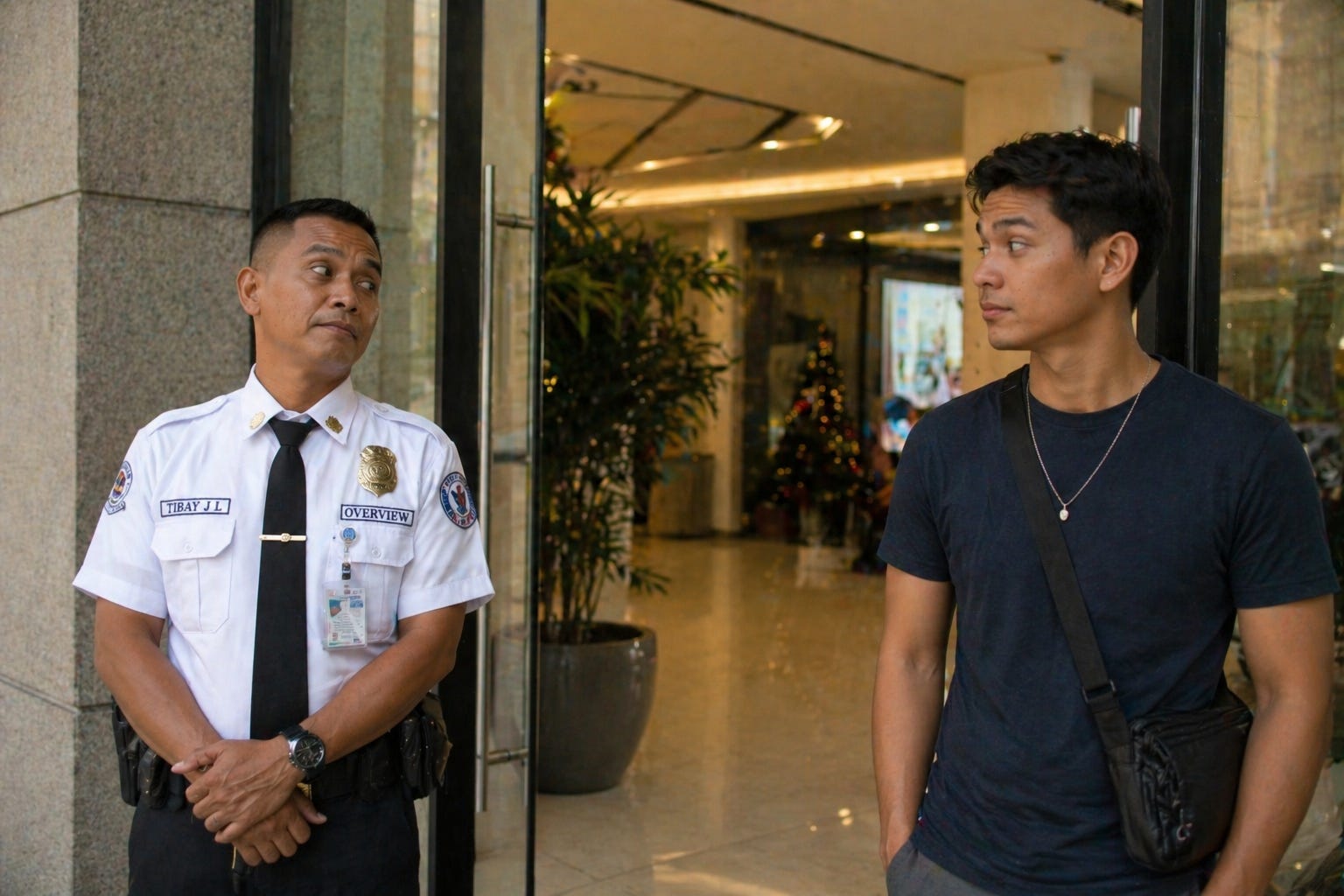
It goes deeper than that, though. The eyebrow raise is the ultimate, silent acknowledgment of existence. If you walk past a security guard at a mall, you don’t need to offer a booming “Good morning!” You catch his eye and give a subtle flick of the brows. He will do it back. It means, “I see you, you see me, we are good.”
If you are trapped in a boring conversation at a party and you catch your friend’s eye across the room, a slow, deliberate raise of the eyebrows translates entirely to, “Get me out of here right now.” It is a silent brotherhood, a shared frequency locals use to check in with one another constantly.
Moving Through Space, Quietly
Even moving your physical body through a space has its own unspoken vocabulary. You are constantly going to be in someone’s way here, or they are going to be in yours. When you need to walk between two people having a conversation on a sidewalk, you don’t push through aggressively, and you don’t say “Excuse me.”
Instead, you do the dip. You drop your head down slightly, extend one arm out in front of you, and point your fingers straight down to the ground as you shuffle quickly through the gap. It is a beautiful, deeply ingrained physical apology.

You are visually lowering your profile, communicating absolute respect for the space they are occupying. You are physically saying, “I am making myself small; forgive my intrusion.” The conversation won’t even pause. They will naturally part like the Red Sea, acknowledging your polite, silent request.
Even settling your restaurant bill operates on this silent frequency. You don’t yell across the dining room. You catch the waiter’s eye, raise your hands, and draw a quick and small rectangle in the air with your index fingers, the universal symbol for the receipt.
You can spend months memorizing the dictionary. You can perfect your pronunciation of ‘ng’. But you aren’t truly fluent until you learn how to shut up and speak the language of the streets without a single word.
Try catching a ride with just a hiss, pointing the direction with just your mouth, and asking for the bill with just a small rectangle formed by your hands raised. Oddly enough, you have just learned the quiet language of the Filipinos.